
Access Restricted for EU Residents
You are attempting to access a website operated by an entity not regulated in the EU. Products and services on this website do not comply with EU laws or ESMA investor-protection standards.
As an EU resident, you cannot proceed to the offshore website.
Please continue on the EU-regulated website to ensure full regulatory protection.
Tuesday Apr 14 2026 10:38

18 min

How to Trade Bitcoin (BTC/USD) CFDs in South Africa: As digital currencies continue to gain traction globally, Bitcoin remains at the forefront of this financial revolution.
Crypto trading for beginners: In South Africa, trading Bitcoin through Contracts for Difference (CFDs) has become increasingly popular among traders. This guide will provide a comprehensive overview of how to trade Bitcoin CFDs in South Africa, focusing on essential strategies, tools, and regulations.
Definition of CFDs
Contracts for Difference (CFDs) are financial derivatives that allow traders to speculate on the price movements of assets without owning the underlying asset. When trading Bitcoin CFDs, you are wagering on the price fluctuations of Bitcoin against a currency, such as the US dollar.
When you open a CFD trade on Bitcoin, you agree to exchange the difference in the asset's price from the moment you open the position to when you close it. If the price increases and you bought the contract, you would realize a gain. Conversely, if the price decreases, you would incur a loss.

Feature | Spot Trading (Buying BTC) | CFD Trading |
|---|---|---|
Ownership | You own the Bitcoin | No ownership (Price speculation) |
Storage | Requires a Digital Wallet | Held in a Brokerage Account |
Leverage | Usually 1:1 (Limited) | Often up to 1:2 or higher for retail |
Short Selling | Difficult/Restricted | Built-in functionality |
Regulation | Varies (often unregulated) | Usually highly regulated |


Bitcoin Market Overview
Before trading Bitcoin CFDs, it is crucial to understand the cryptocurrency market. Bitcoin is known for its high volatility, which creates both risks and opportunities. Keeping an eye on market trends, global economic events, and technological developments is essential for informed trading.
Market Demand and Supply
The price of Bitcoin is primarily driven by the dynamics of supply and demand. When demand for Bitcoin rises, whether due to increased interest from traders, institutional adoption, or general market enthusiasm, prices tend to increase. Conversely, if demand decreases—perhaps because of negative news, regulatory uncertainties, or market saturation—the price can drop. Limited supply, as dictated by the Bitcoin protocol (with a maximum of 21 million coins), adds a unique layer to its price behavior. As more people enter the market and seek to acquire Bitcoin, the scarcity can drive prices higher.
Market Sentiment
Market sentiment plays a pivotal role in determining Bitcoin prices. This sentiment is shaped by various factors, including news events, regulatory developments, and broader economic conditions. Positive news, such as large corporations embracing Bitcoin or favorable regulatory announcements, can create optimism among traders and lead to price increases. Conversely, negative news—such as regulatory crackdowns or security breaches—can instill fear and result in significant sell-offs. Sentiment analysis, therefore, is crucial for traders looking to anticipate price movements based on public perception and emotional responses.
Technological Developments
Advancements in blockchain technology and Bitcoin's infrastructure can also influence market dynamics. Improvements in transaction speed, security features, and scalability can enhance user experience and increase adoption, leading to higher prices. Additionally, developments such as Bitcoin forks or protocol upgrades may create waves in the market, impacting investor confidence. As technological innovations continue to unfold, they can either bolster or undermine the overall perception of Bitcoin, thereby affecting its price. Understanding these factors can help traders make informed decisions regarding their positions in the market.
Choosing a CFD Broker
When trading Bitcoin CFDs, selecting a reliable broker is critical. One highly recommended platform is Markets.com, known for its user-friendly interface, extensive educational resources, and robust trading tools.
Features of Markets.com
Markets.com operates under several reputable authorities, including CySEC (Europe), ASIC (Australia), and the FSCA (South Africa). This ensures that client funds are kept in segregated accounts and that traders are protected by features like Negative Balance Protection, preventing you from losing more than your initial investment.
The platform provides access to over 4,700 financial instruments. While it is a leader in Bitcoin and Crypto CFDs, users can diversify through shares, global indices (like the S&P 500), commodities (gold, oil), and ETFs. This "one-stop-shop" approach allows for seamless portfolio management.
The Markets.com Academy is tailored for growth. It offers real-time market analysis, expert webinars, and in-depth articles. Beginners can utilize a risk-free demo account to practice strategies before committing real capital, while advanced traders benefit from integrated TradingView charts and sentiment tools.

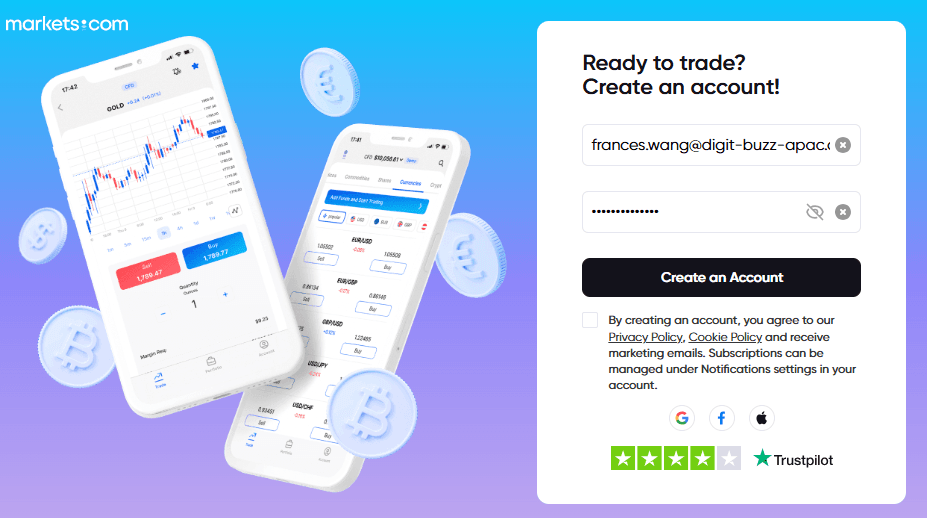
Register: Visit the Markets.com website and complete the registration process by providing your personal information.
Verification: Verify your identity by submitting the necessary documents, such as ID or proof of address.
Deposit Funds: Choose a payment method and deposit funds into your trading account.
Choose Trading Tool: Select a trading tool or platform that suits your style, whether it be web-based or a mobile app.
Types of Trading Strategies
To navigate the Bitcoin market effectively, consider the following trading strategies:
1. Day Trading
Day trading is the most high-intensity approach. Traders open and close all positions within a single trading day to capitalize on intraday volatility. Because the crypto market never sleeps, "day" trading in Bitcoin often involves watching 15-minute or 1-hour charts. Success requires a deep understanding of technical indicators and the discipline to exit positions quickly to avoid overnight risks.
2. Swing Trading
Swing trading is designed for those who cannot watch the markets 24/7. Traders look for "swings" in price—short-to-medium-term fluctuations that play out over several days or weeks. By analyzing daily or 4-hour charts, swing traders aim to catch the meat of a trend, entering when a bottom is confirmed and exiting as the momentum slows down. This approach balances technical analysis with a broader view of market sentiment.
3. Position Trading (HODLing)
Position trading, often referred to in the crypto community as "HODLing," is a long-term strategy. Investors ignore short-term price "noise" and focus on the fundamental value of Bitcoin over months or years. This strategy requires the least amount of active monitoring but the highest level of emotional resilience, as you must hold through significant market corrections.

Effective risk management is crucial for protecting your capital. Here are some techniques to consider:
Set Stop-Loss Orders: A stop-loss order automatically closes your position at a predetermined price to limit potential losses.
Position Sizing: Determine the appropriate size of each trade based on your total portfolio size and risk tolerance.
Diversification: Don't put all your funds into a single asset. Diversifying your portfolio can help mitigate risk.
Fundamental Analysis
Fundamental analysis involves evaluating the factors that might influence Bitcoin’s price over time. Consider the following:

source: tradingview
Technical Analysis
Technical analysis relies on historical price patterns and trading volumes to guide trading decisions. Key concepts include:

Log In: Access your Markets.com account and navigate to the trading platform.
Select Bitcoin CFDs: Find Bitcoin CFDs under the cryptocurrency section.
Analyze the Market: Review charts, indicators, and market news before placing your trade.
Choose Your Position: Decide whether to go long (buy) or short (sell) based on your analysis.
Set Your Parameters: Enter your desired trade size, set stop-loss and take-profit levels if applicable, and execute the trade.
To close a trade, access your open positions within the trading platform, select the Bitcoin trade, and click on the close option.
Review your gains or losses before confirming the closure.
Understanding Tax Responsibilities
In South Africa, trading Bitcoin may have tax implications that you need to consider:
Capital Gains Tax: Any profits made from trading Bitcoin CFDs may be subject to capital gains tax. Ensure you understand your liability and keep proper records of your trades.
Consult a Tax Professional: It can be beneficial to consult with a tax advisor knowledgeable in cryptocurrency regulations to ensure compliance.
Bitcoin Trading Myths
Bitcoin Trading Is Only for Tech Experts: While understanding technology is beneficial, anyone can learn to trade Bitcoin with the right resources.
It’s Too Late to Start Trading Bitcoin: Many perceive that Bitcoin is past its prime, but the market continues to evolve, providing new opportunities.
Emotional Trading
One of the biggest pitfalls in trading is allowing emotions to dictate decisions. Developing a solid trading plan and sticking to it can help mitigate this issue.
Trading Bitcoin CFDs in South Africa offers exciting possibilities for those willing to learn and adapt. By understanding how CFDs work, analyzing market trends, and employing effective strategies, traders can better navigate this dynamic environment. With reliable platforms like Markets.com, beginners have access to robust tools and resources to enhance their trading journeys. Always remember to manage risks and stay informed about the broader market landscape to thrive in this exhilarating field.

Looking to trade crypto CFDs? Choose Markets.com for a user-friendly platform, competitive spreads, and a wide range of assets. Take control of your trading journey today! Sign up now and unlock the tools and resources you need to succeed in the exciting world of CFDs. Start trading!
Risk Warning: This article is provided for informational purposes only and does not constitute investment advice, investment research, or a recommendation to trade. The views expressed are those of the author and do not necessarily reflect the position of Markets.com. When considering shares, indices, forex (foreign exchange), and commodities for trading and price predictions, remember that trading CFDs involves a significant degree of risk and may not be suitable for all investors. Leveraged products can result in capital loss. Past performance is not indicative of future results. Before trading, ensure you fully understand the risks involved and consider your investment objectives and level of experience. Cryptocurrency CFD trading restrictions may apply depending on jurisdiction.
Latest
View all
Thursday, 8 October 2026
29 min

Thursday, 8 October 2026
29 min

Thursday, 8 October 2026
31 min


 EN
EN





